... Or at least most of them don't.
Over the last six months I've spoken to many young people both as friends and just in passing on matters of a political nature in Uganda. Many of them hesitate to talk to me about political issues or at times will reflect on Ugandan politics as a joke.
Some of my friends also claim to be apolitical which in their minds means not supporting a particular party rather than not being political. Those who fall into this category often have well developed personal philosophies and theories relating to politics in Uganda and are frustrated by human rights abuses and corruption.
In Northern Uganda I met more people who openly criticized the government which is likely related to their experiences with conflict and historical structures of violence and political struggles (Finnstrom, 2008). While I was sitting in an office in Lira my colleague looked at a calendar entitled "African Leaders" and said more like "African Dictators" after commenting about the restrictions placed on opposition parties in Uganda. After looking at about 10 of the leaders and suggesting three or four that I thought might be dictators (or at least be dictatoresque), he smirked and said "you missed a few."
Today when I asked one of my colleagues in Kampala what his aspirations were for his newborn daughter he said "she can be anything, although I hope she won't be a politician." When I asked why he said because of the uncertainty (read insecurity) associated with that kind of life.
Although their participation in political dialogue and their opinions differ rather dramatically the one thing that most of these people have in common is that none of them vote because they don't see the point in participating in a political system which always turns out the same way.
This stands in striking contrast to the experience that I had as a door to door canvasser on behalf of a politician during the Federal election last year in Ottawa. I would frequently knock on doors only to have a youth answer and tell me they did not plan to vote because they felt like their voices would not be heard.
This is the same sentiment but the settings are almost completely opposite. In Canada we have an open press that reports frequently and openly on politics even if with some bias whereas the Ugandan press is only relatively open and much of it is state controlled or sponsored. In Canada there is freedom of association and protest, where as in Uganda protestors are met with bullets and tear gas. In Canada there are many avenues for political participation in comparison with Uganda where there are relatively few. Finally, in Canada we have a free and fair electoral system (minus the recent harassing phone calls complained about by some voters).
As a very political individual, I find it hard to reconcile these two realities. I find it even more difficult to understand why young Canadians would choose not to vote or participate in the political process in other ways when there are so many young people around the world with the desire to influence their countries' political systems and economies who don't have the opportunity to do so.
Just some food for thought.
Thursday, March 29, 2012

Wednesday, March 14, 2012
Kony 2012 Part III: Reaction in Northern Uganda
Last week when I first posted about Kony 2012 one of my friends asked me about how Northern Ugandans felt about the movie. At the time I didn't know, very few Northern Ugandans have consistent access to the internet so it was slow to make waves.
That changed yesterday when an organization called AIYNET held a public showing of Kony 2012 in Lira, where I recently conducted field work. Unfortunately I was unable to attend the screening since I'm currently in Nebbi, but I was able to convince my colleagues in Lira.
When I spoke to my friend and colleague Mike Kitara (with permission) over the phone about it this morning, he said in is usual friendly tone that the film provoked a lot of debate in Lira. He indicated that the film included out of date facts, including the suggestion that Kony was still in Uganda and that the situation remained dangerous, and that many of the people who attended the screening saw the film as a cash grab.
More importantly people both questioned the timing of the release of the film since the attrocities it describes ended in 2006 and people even went as far as to question the decision to show the film at all in Lira.
You might also be interested to know that over the weekend New Vision, one of Uganda's leading national newspapers ran an article indicating that while the government appreciated the renewed attention on catching Kony, that no one should misinterpret the campaign to signify that the Lord's Resistance Army remains active in Northern Uganda.
Even if the increased awareness of the LRA does bring about Kony's demise it must not entitle anyone to feel justice in participating in the Kony 2012 campaign. The world sat by while 65,000 children were kidnapped and hundreds of thousands of Northern Ugandans were murdered, maimed, displaced and raped including some of my friends and people I've met through work. A trial at the ICC will bring little peace to those who've lost loved ones and have otherwise been affected by the LRA.
What we can learn from this is that in the future we need to act quickly and in unison to stop mass violation of human rights and the laws of war. Before 65,000 more children are kidnapped.
Let's work together and stop the use of child soldiers.
http://childsoldiersinitiative.org/
That changed yesterday when an organization called AIYNET held a public showing of Kony 2012 in Lira, where I recently conducted field work. Unfortunately I was unable to attend the screening since I'm currently in Nebbi, but I was able to convince my colleagues in Lira.
When I spoke to my friend and colleague Mike Kitara (with permission) over the phone about it this morning, he said in is usual friendly tone that the film provoked a lot of debate in Lira. He indicated that the film included out of date facts, including the suggestion that Kony was still in Uganda and that the situation remained dangerous, and that many of the people who attended the screening saw the film as a cash grab.
More importantly people both questioned the timing of the release of the film since the attrocities it describes ended in 2006 and people even went as far as to question the decision to show the film at all in Lira.
You might also be interested to know that over the weekend New Vision, one of Uganda's leading national newspapers ran an article indicating that while the government appreciated the renewed attention on catching Kony, that no one should misinterpret the campaign to signify that the Lord's Resistance Army remains active in Northern Uganda.
Even if the increased awareness of the LRA does bring about Kony's demise it must not entitle anyone to feel justice in participating in the Kony 2012 campaign. The world sat by while 65,000 children were kidnapped and hundreds of thousands of Northern Ugandans were murdered, maimed, displaced and raped including some of my friends and people I've met through work. A trial at the ICC will bring little peace to those who've lost loved ones and have otherwise been affected by the LRA.
What we can learn from this is that in the future we need to act quickly and in unison to stop mass violation of human rights and the laws of war. Before 65,000 more children are kidnapped.
Let's work together and stop the use of child soldiers.
http://childsoldiersinitiative.org/
Friday, March 9, 2012
Kony 2012 Part II: My Letter to Prime Minister Harper
I believe in practicing what I preach. While I still find the Kony 2012 campaign highly flawed I also believe that Kony should be arrested and that steps should be taken by the international community to fully dismantle what remains of the LRA.
This evening I composed an email to Prime Minister Harper outlining my concerns and demanding that Kony be brought to justice.
If you would like to send him your own email he can be reached at:
stephen.harper@parl.gc.ca
If you are a bit more sentimental and write him a letter you can send it to the following address:
Office of the Prime Minister
80 Wellington Street
Ottawa, ON K1A 0A2
My email read as follows:
Dear Prime Minister Harper,
I am writing to you today about Joseph Kony.
My name is Kirsten Van Houten and I am currently working as a CIDA intern in Uganda where I am a Peace and Conflict Officer with the Uganda Cooperative Alliance. The project that I am working on is focused on alleviating poverty for poor rural farmers in Northern Uganda, including in areas affected by the Northern War and the Lord's Resistance Army. I am currently in Arua in the West Nile Region having arrived from Lira and Masindi where I have been conducting conflict-sensitivity training for cooperative members and conducting research to identify conflict indicators for the project.
I am sure you have received several emails over the last few days resulting from the Kony 2012 campaign. While I do not agree with how the campaign is being orchestrated and recognize that it is missing some key facts, I too believe that Joseph Kony must be stopped.
As you know, since 1988 Joseph Kony has kidnapped over 66,000 children who have been forced to work as child soldiers and sex slaves. In addition the LRA is known for its brutal attacks against civilian populations which include rape, murder and mutilation which breaches International Humanitarian Law under the Rome Convention. While the LRA's attacks were predominantly centered in Northern Uganda since 2008 they have moved to the Democratic Republic of the Congo and the Central African Republic. I'm sure you are aware of the conflict which has raged in the DRC since 1998 and has claimed over 5 million lives (directly or indirectly) according to the International Rescue Committee.
In 2005 the International Criminal Court issued an arrest warrant for Mr. Kony. The Ugandan army and the Congolese armed forces are currently searching for Kony in the DRC. Both of these armies have been accused of poor discipline and themselves violating international humanitarian law through the use of child soldiers and attacks on civilian population.
Mr. Prime Minister, Joseph Kony needs to be arrested as soon as possible. While I am not an expert on international military operations I implore you to take action either to support the Ugandan and Congolese troops searching for Kony while complying with international humanitarian law or to support a UN or African Peacekeeping mission to assist in his arrest.
However, I would also like to ask you to take a few more steps. While it is important that Mr. Kony be brought to justice, his arrest alone will not dismantle the LRA or heal the damage which it has caused. As a result I suggest that you send a delegation to facilitate peace talks with the remaining members of the LRA. Further, I would also suggest that that you should provide funding to organizations such as War Child Canada, Save the Children and the Child Soldier Initiative who can provide assistance in disarming, demobilizing, rehabilitating and reintegrating child soldiers back into their community.
In addition, I would like to stress that in the event that Kony is arrested and brought to trial in front of the ICC it should not entitle any Canadian to feel a sense of justice because we as Canadians and as members of the international community have allowed the LRA to operate with impunity for far to long and no justice will be felt by those who lost loved ones to this army in East Africa. In the future rather than waiting for over twenty years Canada should act as quickly and early as possible to prevent such grave violations of international humanitarian and human rights law.
I believe that Canada still has the capacity to be a leader in international human rights. Arrest Kony, support Disarmament, Demobilization, Rehabilitation and Reintegration and recognize our Responsibility to Protect.
Sincerely,
Ms. Kirsten Van Houten
This evening I composed an email to Prime Minister Harper outlining my concerns and demanding that Kony be brought to justice.
If you would like to send him your own email he can be reached at:
stephen.harper@parl.gc.ca
If you are a bit more sentimental and write him a letter you can send it to the following address:
Office of the Prime Minister
80 Wellington Street
Ottawa, ON K1A 0A2
My email read as follows:
Dear Prime Minister Harper,
I am writing to you today about Joseph Kony.
My name is Kirsten Van Houten and I am currently working as a CIDA intern in Uganda where I am a Peace and Conflict Officer with the Uganda Cooperative Alliance. The project that I am working on is focused on alleviating poverty for poor rural farmers in Northern Uganda, including in areas affected by the Northern War and the Lord's Resistance Army. I am currently in Arua in the West Nile Region having arrived from Lira and Masindi where I have been conducting conflict-sensitivity training for cooperative members and conducting research to identify conflict indicators for the project.
I am sure you have received several emails over the last few days resulting from the Kony 2012 campaign. While I do not agree with how the campaign is being orchestrated and recognize that it is missing some key facts, I too believe that Joseph Kony must be stopped.
As you know, since 1988 Joseph Kony has kidnapped over 66,000 children who have been forced to work as child soldiers and sex slaves. In addition the LRA is known for its brutal attacks against civilian populations which include rape, murder and mutilation which breaches International Humanitarian Law under the Rome Convention. While the LRA's attacks were predominantly centered in Northern Uganda since 2008 they have moved to the Democratic Republic of the Congo and the Central African Republic. I'm sure you are aware of the conflict which has raged in the DRC since 1998 and has claimed over 5 million lives (directly or indirectly) according to the International Rescue Committee.
In 2005 the International Criminal Court issued an arrest warrant for Mr. Kony. The Ugandan army and the Congolese armed forces are currently searching for Kony in the DRC. Both of these armies have been accused of poor discipline and themselves violating international humanitarian law through the use of child soldiers and attacks on civilian population.
Mr. Prime Minister, Joseph Kony needs to be arrested as soon as possible. While I am not an expert on international military operations I implore you to take action either to support the Ugandan and Congolese troops searching for Kony while complying with international humanitarian law or to support a UN or African Peacekeeping mission to assist in his arrest.
However, I would also like to ask you to take a few more steps. While it is important that Mr. Kony be brought to justice, his arrest alone will not dismantle the LRA or heal the damage which it has caused. As a result I suggest that you send a delegation to facilitate peace talks with the remaining members of the LRA. Further, I would also suggest that that you should provide funding to organizations such as War Child Canada, Save the Children and the Child Soldier Initiative who can provide assistance in disarming, demobilizing, rehabilitating and reintegrating child soldiers back into their community.
In addition, I would like to stress that in the event that Kony is arrested and brought to trial in front of the ICC it should not entitle any Canadian to feel a sense of justice because we as Canadians and as members of the international community have allowed the LRA to operate with impunity for far to long and no justice will be felt by those who lost loved ones to this army in East Africa. In the future rather than waiting for over twenty years Canada should act as quickly and early as possible to prevent such grave violations of international humanitarian and human rights law.
I believe that Canada still has the capacity to be a leader in international human rights. Arrest Kony, support Disarmament, Demobilization, Rehabilitation and Reintegration and recognize our Responsibility to Protect.
Sincerely,
Ms. Kirsten Van Houten
Wednesday, March 7, 2012
Kony 2012
Several People have asked if I can include sources in this blog post. Much of the information comes from books which I don't have with me in Arua but I can give you the title and the author of the books which the information comes from and that you can refer to for further information.
Also to give you some additional context, I have an M.A. in International Development Studies from Dalhousie University and wrote my thesis on Armed Violence in the DRC. I have presented a couple of conferences on the topic and I was a member of War Child Dalhousie. I have also participated in the Gulu Walk which does a fantastic job of raising awareness about the use of Child Soldiers by the LRA and I have volunteered with the All Party Parliamentary Committee on the Prevention of Genocide. I really appreciate that so many people have taken the time to read this post and send me feedback.
I have spent the last four weeks in Northern Uganda and will be here for one more week. I am currently conducting research through which to identify conflict indicators for the project that I'm working on. I have also just finished training over 120 people in conflict sensitivity and conflict transformation with help from the Centre for Conflict Resolution. My work has been in Lira, which was directly affected by Joseph Kony's Northern War, Masindi where many of the internally displaced people from the Northern War resettled between 1988 and 2008 and West Nile which receives refugees from North Eastern DRC which is currently being affected by the LRA among other things.
When I was in Lira last week I met a child soldier for the first time. It was a 16 year old boy who was kidnapped when he was about 7 and released when he was about 14. He is not in grade 6 at school and is being cared for the owner of the hotel I stayed at, not his parents. He didn't talk much and seemed very timid although he warmed up to me over the week that I was staying at the hotel. One of the questions I ask as part of my research is whether participants feel that their communities are peaceful. In Lira, several participants indicated that they were not at peace because they feared the return of Joseph Kony.
Who is Joseph Kony? Joseph Kony is the leader of the Lord's Resistance Army (LRA). Its stated purpose is to enforce the 10 commandments in Uganda and to oppose Musevini's governing party the National Resistance Movement (Aboke Girls, de Temmerman and The Lords Resistance Army Myths and Reality, eds. Allen and Vlassenroot).
If you've watched the film "Kony 2012" you probably didn't get that information, in fact you probably heard that the LRA has no stated objective. That's only one of the factual errors
The LRA emerged out of the Holy Spirit Movement in Northern Ugandan which combines Christianity and traditional beliefs. The LRA started to advance towards Kampala in the late 1980's after Musevini ejected a Northern leader, Okello, out of office in 1986.
When you consider the LRA's tactics including the abduction of children to be used as child soldiers, rape, murder and mutilation. Victims eyes, mouths and ears were often cut off so they could not see or hear the attrocities that were being committed around them or so that they could not tell the authorities (Aboke Girls, de Temmerman). And for years the Ugandan government did nothing about it, until it launched a military operation in 2008 which all but exiled the LRA in Sudan, the DRC and the Central African Republic.
If you haven't seen "Kony 2012" it is a 30 minute film by the organization Invisible Children demanding immediate action in Western countries to demand that Kony be arrested by any means necessary.
I agree that Kony must be stopped, but they are leaving out some information you might care to know.
The first point of the video that I would like to challenge is that the "LRA uses girls as sex slaves and boys as child soldiers." In fact this is a very gendered take on the LRA where both boys and girls are used as child soldiers AND both boys and girls are used as sex slaves, although girls are the more common victim (Aboke Girls, de Temmerman AND They Fight Like Soldiers and Die Like Children, Dallaire). Children are also used to cook, care for wounded soldiers and to carry equipment.
The second point is that Kony has no clear objective which I've already addressed.
Third, the movie claims that Kony enjoys no international support, when in fact he is known to have received direct support from the government of Sudan and from AlQaeda (U.S. Exclusion List for Terrorist Organizations AND The Lords Resistance Army, Myth and Reality).
Fourth, the movie fails to acknowledge that the LRA has not been active in Northern Uganda since at least 2008 and that they now operate in North-Eastern Democratic Republic of the Congo and the Central African Republic (Dancing in the Glory of Monsters, Stearns). That's where the movie falls apart. The U.S. did send 100 troops to Uganda to support UPDF (read Ugandan army) operations against the LRA, but since they aren't in Uganda, the operation also requires support from Congolese and CAR troops. I don't know much about the CAR but I do know that the Congolese Army does not have the capacity to hunt down Kony (I wrote my M.A. Thesis on the DRC so I'm not including a citation here if you want to read my thesis you can google my name).
And one might also ask why the group is supporting the use of a military solution at all considering the fact that the Ugandan Army has also been accused of using Child Soldiers, not repatriating returned abductees with their families and committing rape, as has the Congolese army.
I'm also concerned about the treatment of the subject of Child Soldiers by the film. First as my colleague Tanja Bergen points out, the fact they are showing video clips of a young Jacob crying over the loss of his brother, at an age where he could not have consented to be in the video is highly questionable from a research ethics standpoint. The second thing is that the movie oversimplifies what happens to returned child soldiers. Child soldiers who are rescued or escape are rarely able to return to their homes either because their parents were killed or because of the shame that their actions have brought to their families and communities. If these former abductees are lucky, they get to participate in a rehabilitation program led by UNICEF, Save the Children or War Child but many don't and their families and communities simply don't have the resources to support them (They Fight Like Soldiers and they Die Like Children, Dallaire). On another point you might notice that while the film focuses on the use of Child Soldiers it discusses the other atrocities committed by the LRA very little. This is likely because they would have to acknowledge the the abducted children are forced to kill, rape and mutilate their family members and others which makes them "Victim-perpetrators" which means that they were forced to commit crimes through their victimization and were revictimized through the process. And of course, that would just confuse people... (?)
As a fundraiser last year, I learned that sometimes it was better to have less knowledge on an organization to try to get people to support it because it raised fewer questions and made it simpler to explain, and perhaps that's what Invisible Children is going for.
When Amnesty International runs advocacy campaigns, they do not ask for money anywhere in the body of their campaign. However the fundraising component of this campaign is quite apparent as they indicate that in order to receive an advocacy kit that one must commit to making monthly donations. What is particularly worrisome about that is that the campaign targets you people who are least able to make that form of commitment. As my friend Jesse points out Invisible Children has never been externally audited and has other questionable rankings as a charitable organization.
Any reputable add campaign should promote activism before donations. Full Stop.
Although I think that the rhetoric the movie uses and the methods it is suggesting for activism are interesting and relatively effective I am also going to take a moment to cover on some of the theoretical underpinnings that bug me about the film.
First, I find it highly problematic that the film focuses on a small white child to try to help viewers relate to the plight of child soldiers. Although the kid is cute I think this undermines the viewers compassion and their capacity to understand that childhood should have universal norms.
The second problem that I think is more significant is that there is no discussion of what the victims of the LRA would like to see happen. Many of the former heads of the LRA have been subject to amnesty laws and have participated in traditional peace processes. Although I would personally love to see Kony tried in front of the International Criminal Court, I am not certain that, that is what most of Northern Ugandan's want.
To conclude, I would like to point out the almost complete absence of the voices of Northern Ugandans in the video which I think is its biggest flaw.
Joseph Kony must be stopped, together we can do something about it.
Like the video suggests, you can send your MP or Prime Minister Harper/Obama or whoever your leader is a letter, you can organize a march, put up posters and spread the word. But you can do that without Invisible Children, and certainly without donating to them.
If you want to watch the video: http://www.youtube.com/watch?v=Y4MnpzG5Sqc
If you would like to read about the Norther War I would recommend reading "The Aboke Girls" or referring to War Child's Website.
If you would like to read more about Child Soldier's you can read "They Fight like Soldiers and Die Like Children" by Romeo Dalliare
If you would like to read about Justice in East Africa you can read "Drink the Bitter Root.
If you would like to send me an email I can be reached at k_van_houten@hotmail.com
Also to give you some additional context, I have an M.A. in International Development Studies from Dalhousie University and wrote my thesis on Armed Violence in the DRC. I have presented a couple of conferences on the topic and I was a member of War Child Dalhousie. I have also participated in the Gulu Walk which does a fantastic job of raising awareness about the use of Child Soldiers by the LRA and I have volunteered with the All Party Parliamentary Committee on the Prevention of Genocide. I really appreciate that so many people have taken the time to read this post and send me feedback.
I have spent the last four weeks in Northern Uganda and will be here for one more week. I am currently conducting research through which to identify conflict indicators for the project that I'm working on. I have also just finished training over 120 people in conflict sensitivity and conflict transformation with help from the Centre for Conflict Resolution. My work has been in Lira, which was directly affected by Joseph Kony's Northern War, Masindi where many of the internally displaced people from the Northern War resettled between 1988 and 2008 and West Nile which receives refugees from North Eastern DRC which is currently being affected by the LRA among other things.
When I was in Lira last week I met a child soldier for the first time. It was a 16 year old boy who was kidnapped when he was about 7 and released when he was about 14. He is not in grade 6 at school and is being cared for the owner of the hotel I stayed at, not his parents. He didn't talk much and seemed very timid although he warmed up to me over the week that I was staying at the hotel. One of the questions I ask as part of my research is whether participants feel that their communities are peaceful. In Lira, several participants indicated that they were not at peace because they feared the return of Joseph Kony.
Who is Joseph Kony? Joseph Kony is the leader of the Lord's Resistance Army (LRA). Its stated purpose is to enforce the 10 commandments in Uganda and to oppose Musevini's governing party the National Resistance Movement (Aboke Girls, de Temmerman and The Lords Resistance Army Myths and Reality, eds. Allen and Vlassenroot).
If you've watched the film "Kony 2012" you probably didn't get that information, in fact you probably heard that the LRA has no stated objective. That's only one of the factual errors
The LRA emerged out of the Holy Spirit Movement in Northern Ugandan which combines Christianity and traditional beliefs. The LRA started to advance towards Kampala in the late 1980's after Musevini ejected a Northern leader, Okello, out of office in 1986.
When you consider the LRA's tactics including the abduction of children to be used as child soldiers, rape, murder and mutilation. Victims eyes, mouths and ears were often cut off so they could not see or hear the attrocities that were being committed around them or so that they could not tell the authorities (Aboke Girls, de Temmerman). And for years the Ugandan government did nothing about it, until it launched a military operation in 2008 which all but exiled the LRA in Sudan, the DRC and the Central African Republic.
If you haven't seen "Kony 2012" it is a 30 minute film by the organization Invisible Children demanding immediate action in Western countries to demand that Kony be arrested by any means necessary.
I agree that Kony must be stopped, but they are leaving out some information you might care to know.
The first point of the video that I would like to challenge is that the "LRA uses girls as sex slaves and boys as child soldiers." In fact this is a very gendered take on the LRA where both boys and girls are used as child soldiers AND both boys and girls are used as sex slaves, although girls are the more common victim (Aboke Girls, de Temmerman AND They Fight Like Soldiers and Die Like Children, Dallaire). Children are also used to cook, care for wounded soldiers and to carry equipment.
The second point is that Kony has no clear objective which I've already addressed.
Third, the movie claims that Kony enjoys no international support, when in fact he is known to have received direct support from the government of Sudan and from AlQaeda (U.S. Exclusion List for Terrorist Organizations AND The Lords Resistance Army, Myth and Reality).
Fourth, the movie fails to acknowledge that the LRA has not been active in Northern Uganda since at least 2008 and that they now operate in North-Eastern Democratic Republic of the Congo and the Central African Republic (Dancing in the Glory of Monsters, Stearns). That's where the movie falls apart. The U.S. did send 100 troops to Uganda to support UPDF (read Ugandan army) operations against the LRA, but since they aren't in Uganda, the operation also requires support from Congolese and CAR troops. I don't know much about the CAR but I do know that the Congolese Army does not have the capacity to hunt down Kony (I wrote my M.A. Thesis on the DRC so I'm not including a citation here if you want to read my thesis you can google my name).
And one might also ask why the group is supporting the use of a military solution at all considering the fact that the Ugandan Army has also been accused of using Child Soldiers, not repatriating returned abductees with their families and committing rape, as has the Congolese army.
I'm also concerned about the treatment of the subject of Child Soldiers by the film. First as my colleague Tanja Bergen points out, the fact they are showing video clips of a young Jacob crying over the loss of his brother, at an age where he could not have consented to be in the video is highly questionable from a research ethics standpoint. The second thing is that the movie oversimplifies what happens to returned child soldiers. Child soldiers who are rescued or escape are rarely able to return to their homes either because their parents were killed or because of the shame that their actions have brought to their families and communities. If these former abductees are lucky, they get to participate in a rehabilitation program led by UNICEF, Save the Children or War Child but many don't and their families and communities simply don't have the resources to support them (They Fight Like Soldiers and they Die Like Children, Dallaire). On another point you might notice that while the film focuses on the use of Child Soldiers it discusses the other atrocities committed by the LRA very little. This is likely because they would have to acknowledge the the abducted children are forced to kill, rape and mutilate their family members and others which makes them "Victim-perpetrators" which means that they were forced to commit crimes through their victimization and were revictimized through the process. And of course, that would just confuse people... (?)
As a fundraiser last year, I learned that sometimes it was better to have less knowledge on an organization to try to get people to support it because it raised fewer questions and made it simpler to explain, and perhaps that's what Invisible Children is going for.
When Amnesty International runs advocacy campaigns, they do not ask for money anywhere in the body of their campaign. However the fundraising component of this campaign is quite apparent as they indicate that in order to receive an advocacy kit that one must commit to making monthly donations. What is particularly worrisome about that is that the campaign targets you people who are least able to make that form of commitment. As my friend Jesse points out Invisible Children has never been externally audited and has other questionable rankings as a charitable organization.
Any reputable add campaign should promote activism before donations. Full Stop.
Although I think that the rhetoric the movie uses and the methods it is suggesting for activism are interesting and relatively effective I am also going to take a moment to cover on some of the theoretical underpinnings that bug me about the film.
First, I find it highly problematic that the film focuses on a small white child to try to help viewers relate to the plight of child soldiers. Although the kid is cute I think this undermines the viewers compassion and their capacity to understand that childhood should have universal norms.
The second problem that I think is more significant is that there is no discussion of what the victims of the LRA would like to see happen. Many of the former heads of the LRA have been subject to amnesty laws and have participated in traditional peace processes. Although I would personally love to see Kony tried in front of the International Criminal Court, I am not certain that, that is what most of Northern Ugandan's want.
To conclude, I would like to point out the almost complete absence of the voices of Northern Ugandans in the video which I think is its biggest flaw.
Joseph Kony must be stopped, together we can do something about it.
Like the video suggests, you can send your MP or Prime Minister Harper/Obama or whoever your leader is a letter, you can organize a march, put up posters and spread the word. But you can do that without Invisible Children, and certainly without donating to them.
If you want to watch the video: http://www.youtube.com/watch?v=Y4MnpzG5Sqc
If you would like to read about the Norther War I would recommend reading "The Aboke Girls" or referring to War Child's Website.
If you would like to read more about Child Soldier's you can read "They Fight like Soldiers and Die Like Children" by Romeo Dalliare
If you would like to read about Justice in East Africa you can read "Drink the Bitter Root.
If you would like to send me an email I can be reached at k_van_houten@hotmail.com
Friday, February 24, 2012
Losing Mzee Kato
The first day I arrived in Kampala I attended a salsa dance class with my Canadian colleague Carolyn which was part of a couch surfing event (couch surfing is a community in which people invite travelers to stay on their couch (or beds) while they are in town). It was my first time attempting salsa dance and I was quite amused by the Mzee (swahili for old man) who took my hand and made sure that I got the footing and timing right.
I didn't like salsa as much a swing dancing and was a bit reluctant to venture out on my own so I didn't return to salsa for another month, but after that I began to attend regularly on Thursdays and Saturdays. As it happened Mzee Kato was the head teacher of the salsa lessons at Lotus Mexicana, a Mexican Restaurant owned by an American, and would take me from barley knowing the steps to being able to social dance with some degree of proficiency. Although his English wasn't great, his passion for dancing always shone through and as I got to know him I realized how experienced of a dancer he was. He was also the only Ugandan I've met who actually knew how to swing dance.
On a Thursday night about two weeks ago the Mzee was not leading the lesson, but instead arrived late and watched sitting down which was quite unusual for the spunky 88 year old. One of the other instructors, and my friend, Musa explained that Mzee Kato was sick and needed money for his medication. Knowing that medication costs are relatively low here I quietly inquired about how much he needed and provided the funds. He thanked me repeatedly then and on his way out. Although Mzee Kato looked ill he was walking around and interacting with people and so I assumed since he had the money for the medicine he needed that he would recover. So you can imagine my surprise when two days later my friends called to tell me that he had passed on.
As it turned out the Mzee had Malaria but had decided to go home to his village after dance class rather than back to the hospital. He woke up in the night very ill and did not make it to the hospital in time. It is difficult for many Ugandans to access the healthcare facilities which are available to them, for example I heard from a research participant this week that in order to get urgent medical care in the town of Bweyale you have to drive at least 2 hours to a major city. Although the situation is less dire in the Kampala area, poor road conditions and lack of funds can also hamper access to medicine.
In the days that followed it became apparent how prominent a dancer he was, as his death gained national media attention and brought together a large portion of the dance community. It also deeply affected my friend Musa who worked closely with him as a dancer and who related to him as a relative.
And so I'm taking this opportunity to remember Mzee Kato, who contributed so much to the salsa dance community in Uganda. His contribution lives on through the large salsa dance community in KLA.
I didn't like salsa as much a swing dancing and was a bit reluctant to venture out on my own so I didn't return to salsa for another month, but after that I began to attend regularly on Thursdays and Saturdays. As it happened Mzee Kato was the head teacher of the salsa lessons at Lotus Mexicana, a Mexican Restaurant owned by an American, and would take me from barley knowing the steps to being able to social dance with some degree of proficiency. Although his English wasn't great, his passion for dancing always shone through and as I got to know him I realized how experienced of a dancer he was. He was also the only Ugandan I've met who actually knew how to swing dance.
On a Thursday night about two weeks ago the Mzee was not leading the lesson, but instead arrived late and watched sitting down which was quite unusual for the spunky 88 year old. One of the other instructors, and my friend, Musa explained that Mzee Kato was sick and needed money for his medication. Knowing that medication costs are relatively low here I quietly inquired about how much he needed and provided the funds. He thanked me repeatedly then and on his way out. Although Mzee Kato looked ill he was walking around and interacting with people and so I assumed since he had the money for the medicine he needed that he would recover. So you can imagine my surprise when two days later my friends called to tell me that he had passed on.
As it turned out the Mzee had Malaria but had decided to go home to his village after dance class rather than back to the hospital. He woke up in the night very ill and did not make it to the hospital in time. It is difficult for many Ugandans to access the healthcare facilities which are available to them, for example I heard from a research participant this week that in order to get urgent medical care in the town of Bweyale you have to drive at least 2 hours to a major city. Although the situation is less dire in the Kampala area, poor road conditions and lack of funds can also hamper access to medicine.
In the days that followed it became apparent how prominent a dancer he was, as his death gained national media attention and brought together a large portion of the dance community. It also deeply affected my friend Musa who worked closely with him as a dancer and who related to him as a relative.
And so I'm taking this opportunity to remember Mzee Kato, who contributed so much to the salsa dance community in Uganda. His contribution lives on through the large salsa dance community in KLA.
Thursday, February 9, 2012
I think we might have... Ralph(s)
So I'm currently writing a fairly long post about my trips to Lira and Jinja which I am hoping to finish really soon but I thought I might publish something to hold you over.
I recently acquired two lovely new German room mates who are both German, very tidy etc.
On Tuesday morning I awoke and went to the kitchen only to find small round black pellets all over the sink and our dishes on the drying rack. My immediate thought was "oh no, we have a rat!" I proceeded to diligently clean the counters and rewash all of the dishes. I did notice that some of the little black pellets had some orange fruit attached and briefly wondered if they were seed but I dismissed the thought because why would there be seeds all over our clean dishes?
When my room mate Anna woke up I told her what had happened. Very upset she also started to think about doing more cleaning. As I was getting ready for work my other room mate Ralph got up and Anna suddenly said to me "Kirsten, it wasn't a rat!"
and Ralph added "Yeah, don't you know the difference between papaya seeds and rat droppings?"
The question is, how did Ralph manage to get Papaya seeds all over our clean dishes?
I recently acquired two lovely new German room mates who are both German, very tidy etc.
On Tuesday morning I awoke and went to the kitchen only to find small round black pellets all over the sink and our dishes on the drying rack. My immediate thought was "oh no, we have a rat!" I proceeded to diligently clean the counters and rewash all of the dishes. I did notice that some of the little black pellets had some orange fruit attached and briefly wondered if they were seed but I dismissed the thought because why would there be seeds all over our clean dishes?
When my room mate Anna woke up I told her what had happened. Very upset she also started to think about doing more cleaning. As I was getting ready for work my other room mate Ralph got up and Anna suddenly said to me "Kirsten, it wasn't a rat!"
and Ralph added "Yeah, don't you know the difference between papaya seeds and rat droppings?"
The question is, how did Ralph manage to get Papaya seeds all over our clean dishes?
Sunday, February 5, 2012
Lira and Jinja
I managed to get out of Kampala twice during January, once for work, once for pleasure.
When I returned to work after the Christmas holidays I was anxious to visit the field since my project is primarily focused on Northern Uganda and I had not had the opportunity to go. Fortunately there was an opportunity to visit Lira within the first week so off I went, admittedly without much of a program in mind.
We arrived late on a Wednesday night and I checked in to the hotel that the field staff had booked for me. It, like the guesthouse I stayed at in Kasese, was called the white house, however it was more expensive and was not as nice. The rooms had been set up so that the window and bathroom were at the back of the room and the bed was as the front leaving only a narrow corridor for air to pass through making the hotter than Kampala temperatures even hotter. It was also a bit noisy and dirty. However, not wanting to be high maintenance I decided not to complain and stick it out.

When I did mention to one of my colleagues that I had not slept well because of the heat he ended up recommending a different hotel a bit outside the center of the city. After checking out the location I changed my accommodation and slept well my second two nights at a hotel that really had great service.
The first day I was in Lira I visited a SACCO (credit union) with the Microfinance and Data collection officers in a neighbouring district called Apac (pronouced Apache). They were visiting a SACCO to update their data to be incorporated into a database which is being developed in the district to help track SACCOs performance. This gave me the opportunity to meet with the loans officer who shared with me some of their strengths and weaknesses. I was interested to learn that many women in the district had complained that their husbands' behaviour had changed after receiving loans and it was something they were working on improving.
Once the others got down to business I had little to occupy my time so I decided to explore the area a bit. We had passed through a marsh on the way to the SACCO so I first walked back where I enjoyed watching cows drinking from a stream of water where some boda drivers were washing their bikes. One thing that I really liked about Lira was that people were generally less aggressive in their attempts to get my attention and sell me things. Following my walk, our driver for the day picked me up and we went for lunch. We at mud fish, which is a type of fish that live in the swamps and are caught with spears rather than fishing lines. I quite enjoyed that experience. We then visited a local market which was nice to see. In the market we met a developmentally delayed youth (who the driver referred to as insane) who took quite an interest in my camera so we had a little game of him pointing at something and asking me to take a picture, me doing so and then showing him said pictures. On the way back to the SACCO I mentioned to the driver that I was interested in seeing the inside of one of the round huts that dotted the country side and so he brought me to one that was owned by one of his friends where I was able to see the hut, which is used for cooking and some of the compound's inhabitants.
We returned to the SACCO to find our colleagues still working; fortunately I had brought a book. When that got old I decided to explore some more. This time I walked in the opposite direction from the swamp and found a small nursery school and met the owners. The head teacher names Harriet had decided to set up the school when her advice as a newly graduated teacher was not well received by her colleagues at her first job. She and James, her husband told me that the school opened in 2011 with 47 students and that in November, when the first class was having its graduation ceremony, that the ceremony was attended by some local officials who had been visiting the SACCO and had noticed what was going on. She told me that as a result of the visit they were expecting enrollment to be closer to 100 for the new year. Kind of neat to see the impact that cooperatives can have on their communities.
The next day I attended a training session on Soya beans with the gentleman described in one of my earlier posts who excitedly told us over the long car ride about his friend exploiting resources in the DRC, and the Marketing Manager. Although the ride to and from the Area Cooperative Enterprise was long and the conversation left something to be desired, it was neat to learn a bit more about agricultural practices in Uganda, even if I am allergic to soy bean protein.

My trip to Jinja was a completely different scenario. On the last Friday in January I made a two day-friend. Two day-friends are my term for people who you meet, click with instantly, but who are leaving the city within two days. This was the second two day- friend that I had made and she was a fellow Canadian. I was sitting and waiting for another friend at the national theatre, where there was a film opening taking place which I was not attending, when Tanja approached and asked if I knew what was going. We soon got down to chatting and discovered that we were both from Canada and that she was a research assistant doing work on transitional justice in Northern Uganda and so we compared notes. She spent time with my friend and I and we went for a drink. When she mentioned that she was going to Jinja the next day I asked if I could tag along since I hadn't been yet, and of course she said yes.
So the next morning we headed to the post office to catch the postbus to Jinja. For some reason the bus driver decided to leave 30 minutes early despite the fact that it wasn't full and we were left standing outside the station. Fortunately another friend and told me that one could take a minibus from the old taxi park so we headed in that direction and quickly found several buses waiting to take people to Jinja. After we first arrived in Jinja we hired two bodas to drive us to a coffee shop called Flavours that was in my guidebook. Although we had negotiated the price with the drivers one of them was kind enough to ask for an exorbitant price upon reaching our destination, I laughed and gave him what we negotiated. Flavours coffee shop was a very contemporary coffee shop by Ugandan standards with very artistic decor.
After caffinating ourselves we then headed for the source of the Nile by foot, viewing part of the city on the way. Admission to the source of the Nile is 2000 Ugandan shillings for locals and 10,000 for foreigners. This sort of price difference is common throughout the country at parks and other attractions and part of the reason I refuse to go on safari here (knowing how much less expensive it is in South Africa really doesn't help either). On this occasion I of course paid. Upon entering the park grounds we discovered a well developed craft market along the stairs leading down to the river where I bought a few things to give to people back home in Canada. At the bottom of the stairs we discovered the opportunity to go on a boat tour of the source which we also decided to go on, much to the dismay of one of the people with us, Brendan, who had a significant fear of boats and water. While touring the source we were able to see several species of birds including Kingfishers. There are two small islands which straddle the source of the Nile which is a bubbling spring which sits at the intersection between the Nile and Lake Victoria, one of which has this large tree which is full of different types of birds and is quite stunning save for the bird droppings which make the island appear as if it is covered in snow. On the island we also saw a three meter long lizard of some kind which was also rather neat. We were also briefly let off at the adjacent island where you could stand and have your picture taken with a sign that says "source of the Nile."
We then hopped on the backs of a couple of bodas to see the Bujigali falls, or what used to be the Bujigali falls. As part of the process of harnessing Hydro electric power in Uganda they are damming the Nile river which recently involved the flooding of the falls in Bujigali. Unfortunately this has resulted in the disappearance of the falls although does provide for some interesting scenery where the tops of taller trees are still sticking out through the river. I've also learned that this flooding has been a source of conflict for the community which is being mediated by the Centre for Conflict Resolution, which is one of the organizations I'm working with as part of my internship.
So I'm publishing this post from Lira where I've returned to conduct training and research. More to follow.

When I returned to work after the Christmas holidays I was anxious to visit the field since my project is primarily focused on Northern Uganda and I had not had the opportunity to go. Fortunately there was an opportunity to visit Lira within the first week so off I went, admittedly without much of a program in mind.
We arrived late on a Wednesday night and I checked in to the hotel that the field staff had booked for me. It, like the guesthouse I stayed at in Kasese, was called the white house, however it was more expensive and was not as nice. The rooms had been set up so that the window and bathroom were at the back of the room and the bed was as the front leaving only a narrow corridor for air to pass through making the hotter than Kampala temperatures even hotter. It was also a bit noisy and dirty. However, not wanting to be high maintenance I decided not to complain and stick it out.

When I did mention to one of my colleagues that I had not slept well because of the heat he ended up recommending a different hotel a bit outside the center of the city. After checking out the location I changed my accommodation and slept well my second two nights at a hotel that really had great service.
The first day I was in Lira I visited a SACCO (credit union) with the Microfinance and Data collection officers in a neighbouring district called Apac (pronouced Apache). They were visiting a SACCO to update their data to be incorporated into a database which is being developed in the district to help track SACCOs performance. This gave me the opportunity to meet with the loans officer who shared with me some of their strengths and weaknesses. I was interested to learn that many women in the district had complained that their husbands' behaviour had changed after receiving loans and it was something they were working on improving.
Once the others got down to business I had little to occupy my time so I decided to explore the area a bit. We had passed through a marsh on the way to the SACCO so I first walked back where I enjoyed watching cows drinking from a stream of water where some boda drivers were washing their bikes. One thing that I really liked about Lira was that people were generally less aggressive in their attempts to get my attention and sell me things. Following my walk, our driver for the day picked me up and we went for lunch. We at mud fish, which is a type of fish that live in the swamps and are caught with spears rather than fishing lines. I quite enjoyed that experience. We then visited a local market which was nice to see. In the market we met a developmentally delayed youth (who the driver referred to as insane) who took quite an interest in my camera so we had a little game of him pointing at something and asking me to take a picture, me doing so and then showing him said pictures. On the way back to the SACCO I mentioned to the driver that I was interested in seeing the inside of one of the round huts that dotted the country side and so he brought me to one that was owned by one of his friends where I was able to see the hut, which is used for cooking and some of the compound's inhabitants.
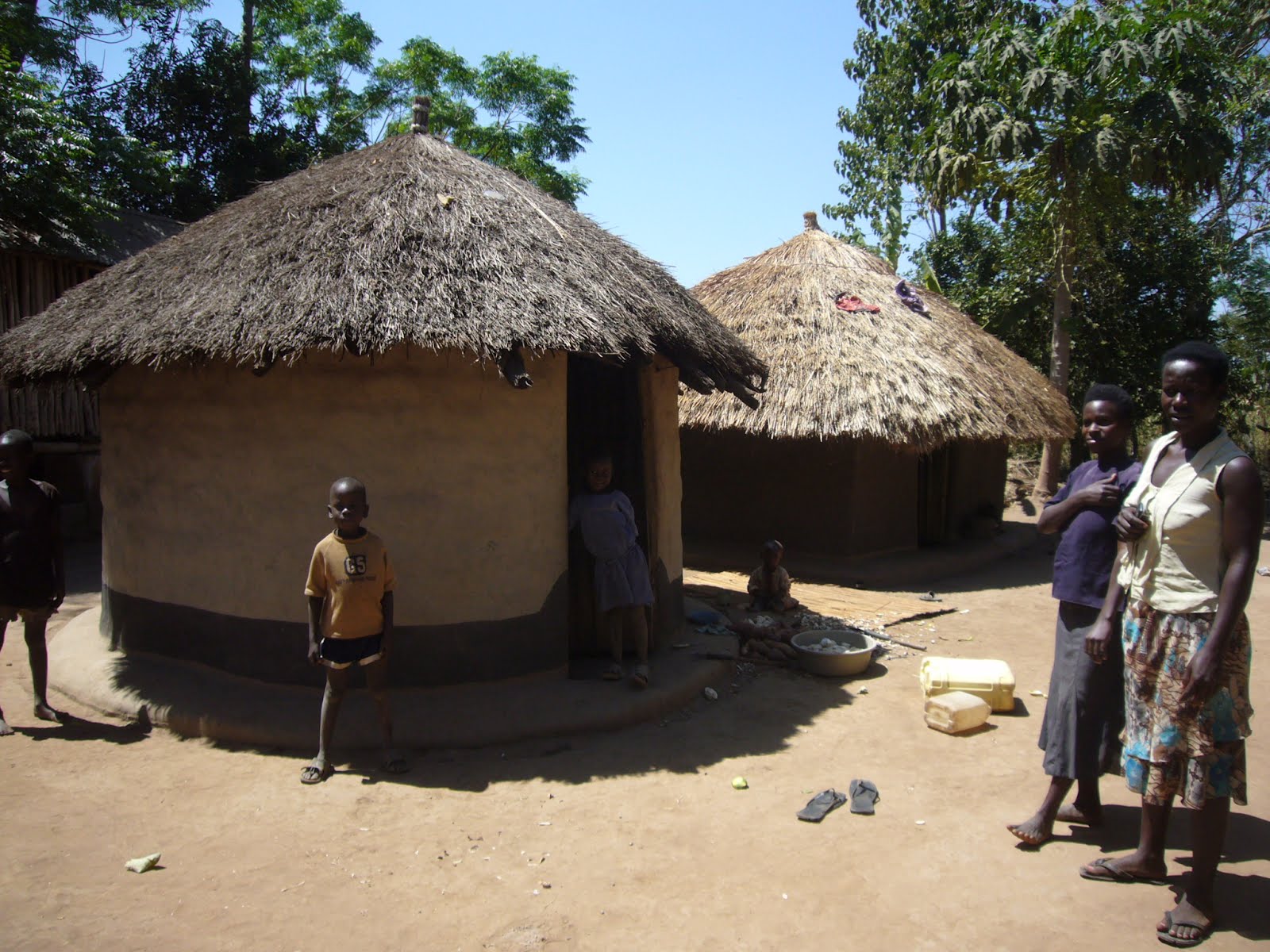
We returned to the SACCO to find our colleagues still working; fortunately I had brought a book. When that got old I decided to explore some more. This time I walked in the opposite direction from the swamp and found a small nursery school and met the owners. The head teacher names Harriet had decided to set up the school when her advice as a newly graduated teacher was not well received by her colleagues at her first job. She and James, her husband told me that the school opened in 2011 with 47 students and that in November, when the first class was having its graduation ceremony, that the ceremony was attended by some local officials who had been visiting the SACCO and had noticed what was going on. She told me that as a result of the visit they were expecting enrollment to be closer to 100 for the new year. Kind of neat to see the impact that cooperatives can have on their communities.
The next day I attended a training session on Soya beans with the gentleman described in one of my earlier posts who excitedly told us over the long car ride about his friend exploiting resources in the DRC, and the Marketing Manager. Although the ride to and from the Area Cooperative Enterprise was long and the conversation left something to be desired, it was neat to learn a bit more about agricultural practices in Uganda, even if I am allergic to soy bean protein.

My trip to Jinja was a completely different scenario. On the last Friday in January I made a two day-friend. Two day-friends are my term for people who you meet, click with instantly, but who are leaving the city within two days. This was the second two day- friend that I had made and she was a fellow Canadian. I was sitting and waiting for another friend at the national theatre, where there was a film opening taking place which I was not attending, when Tanja approached and asked if I knew what was going. We soon got down to chatting and discovered that we were both from Canada and that she was a research assistant doing work on transitional justice in Northern Uganda and so we compared notes. She spent time with my friend and I and we went for a drink. When she mentioned that she was going to Jinja the next day I asked if I could tag along since I hadn't been yet, and of course she said yes.
So the next morning we headed to the post office to catch the postbus to Jinja. For some reason the bus driver decided to leave 30 minutes early despite the fact that it wasn't full and we were left standing outside the station. Fortunately another friend and told me that one could take a minibus from the old taxi park so we headed in that direction and quickly found several buses waiting to take people to Jinja. After we first arrived in Jinja we hired two bodas to drive us to a coffee shop called Flavours that was in my guidebook. Although we had negotiated the price with the drivers one of them was kind enough to ask for an exorbitant price upon reaching our destination, I laughed and gave him what we negotiated. Flavours coffee shop was a very contemporary coffee shop by Ugandan standards with very artistic decor.
After caffinating ourselves we then headed for the source of the Nile by foot, viewing part of the city on the way. Admission to the source of the Nile is 2000 Ugandan shillings for locals and 10,000 for foreigners. This sort of price difference is common throughout the country at parks and other attractions and part of the reason I refuse to go on safari here (knowing how much less expensive it is in South Africa really doesn't help either). On this occasion I of course paid. Upon entering the park grounds we discovered a well developed craft market along the stairs leading down to the river where I bought a few things to give to people back home in Canada. At the bottom of the stairs we discovered the opportunity to go on a boat tour of the source which we also decided to go on, much to the dismay of one of the people with us, Brendan, who had a significant fear of boats and water. While touring the source we were able to see several species of birds including Kingfishers. There are two small islands which straddle the source of the Nile which is a bubbling spring which sits at the intersection between the Nile and Lake Victoria, one of which has this large tree which is full of different types of birds and is quite stunning save for the bird droppings which make the island appear as if it is covered in snow. On the island we also saw a three meter long lizard of some kind which was also rather neat. We were also briefly let off at the adjacent island where you could stand and have your picture taken with a sign that says "source of the
 Nile."
We then hopped on the backs of a couple of bodas to see the Bujigali falls, or what used to be the Bujigali falls. As part of the process of harnessing Hydro electric power in Uganda they are damming the Nile river which recently involved the flooding of the falls in Bujigali. Unfortunately this has resulted in the disappearance of the falls although does provide for some interesting scenery where the tops of taller trees are still sticking out through the river. I've also learned that this flooding has been a source of conflict for the community which is being mediated by the Centre for Conflict Resolution, which is one of the organizations I'm working with as part of my internship.
So I'm publishing this post from Lira where I've returned to conduct training and research. More to follow.

Subscribe to:
Posts (Atom)